
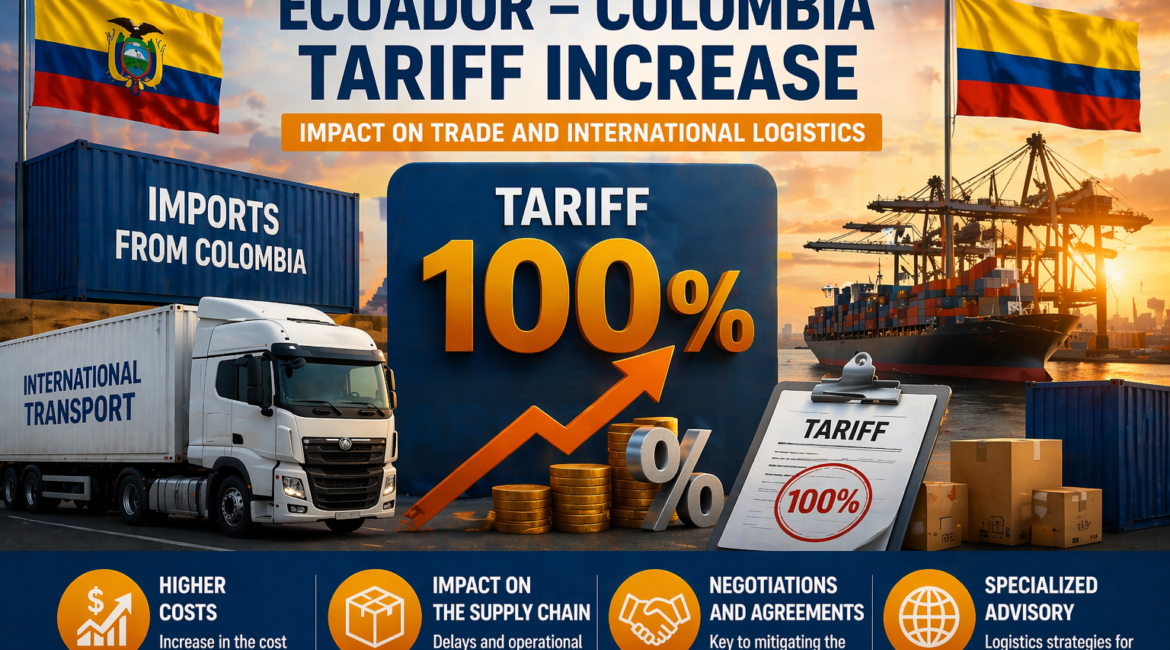
In 2026, Ecuador and Colombia have been at the center of one of the most significant trade tensions in the Andean region in recent decades. Starting on May 1, 2026, the Government of Ecuador officially implemented a 100% tariff on imports from Colombia, a substantial increase from the previously imposed 30% and later 50% tariffs. This measure, which was justified by Quito as a response to border security concerns, has prompted a reciprocal response from Colombia and generated concern among exporters, logistics operators, and business communities in both countries. (elcomercio.com)
Origin and Evolution of the Tariff Increase
The tariff escalation began in early 2026, when the Government of Ecuador, through the Ministry of Production, Foreign Trade, Investment, and Fisheries, imposed a “security tax” of 30% on imports from Colombia. This decision was justified by Ecuadorian authorities as necessary to reinforce national security against drug trafficking and the lack of effective actions from the Colombian government on that front. (elpais.com)
Subsequently, due to what Quito perceived as continued lack of effective measures by Colombia, the tariff was raised to 50% on March 1, 2026. (primicias.ec) Finally, on May 1, 2026, the most significant increase came into effect, with a 100% tariff on Colombian imports into Ecuador. (elcomercio.com)
This escalation did not occur in isolation. Shortly after Ecuador announced its 100% tariff, the Colombian government announced it would also implement a 100% tariff on goods imported from Ecuador, aiming to restore fair trade conditions and respond to Ecuador’s policy. (eluniverso.com)
Official Justifications and Legal Framework
Ecuador: Security Concerns as the Justification
According to official documents and statements from the Ecuadorian National Customs Service (SENAE) and the Ministry of Production, Foreign Trade, and Investments, the tariff increase is based on the need for shared responsibility in combating drug trafficking and organized crime along the shared border. Quito has argued that the Colombian side has not taken effective steps to mitigate these threats, which represent a security risk for Ecuador. (elcomercio.com)
Ecuadorian officials have also emphasized that the increase in tariffs is considered a sovereign measure, aimed at promoting effective cooperation in security matters. (lahora.com.ec)
Colombia: Reciprocity and Trade Defense
On the other hand, the Colombian Ministry of Commerce, Industry, and Tourism has argued that the 100% tariff imposed by Ecuador distorts market conditions, negatively affecting Colombian producers and exporters who compete in the Ecuadorian market. As a result, and after several failed attempts at dialogue, the Colombian government decided to impose an equal 100% tariff on goods imported from Ecuador. (eluniverso.com)
Additionally, Colombian authorities have filed complaints with the Andean Community of Nations (CAN), arguing that Ecuador’s measures may violate the principles of integration and free trade established under the Cartagena Agreement of 1969. (efe.com)
Impacts and Risks for Logistics and International Trade
Logistical Costs and Reduced Bilateral Trade
The 100% tariff increase has a direct impact on import costs, significantly raising the price of Colombian products entering Ecuador and vice versa. For the logistics and international trade sector, this translates into:
- Higher operational costs for importers, distributors, and transporters.
- Possible reduction in trade volume, especially along major land borders like Rumichaca.
- Decreasing appeal of formal trade, with the potential for a rise in informal customs practices or rerouting imports through alternative paths. (expreso.ec)
Diplomatic Tensions and Institutional Framework
The tariff conflict has not only impacted bilateral trade but has also affected regional integration mechanisms such as the Andean Community of Nations (CAN), which is under significant pressure due to the breakdown of traditional free trade agreements between two of its member countries. (elpais.com)
There have also been diplomatic repercussions, with consultations between ambassadors and statements from senior officials reflecting a climate of political tension that extends beyond the purely commercial aspect. (eltiempo.com)
Conclusion and Recommendations for the Logistics Sector
The 100% tariff increase between Ecuador and Colombia represents one of the most significant challenges for bilateral trade in 2026. Beyond the security justification, this measure implies a reconfiguration of logistics, commercial, and risk management strategies for businesses operating in both economies.
Practical recommendations for importers and logistics operators:
- Review and update commercial contracts and cost-sharing clauses, considering the impact of these tariffs.
- Explore alternative supply chains or complementary markets to mitigate risks from elevated tariff barriers.
- Strengthen customs management and compliance by anticipating possible regulatory changes within the Andean Community or other international frameworks.
- Engage in sectoral dialogue with customs and trade associations to ensure alignment of information and actions in response to this evolving conflict.
In a context where border security and commercial policy intersect, strategic planning and expert advice are crucial to maintaining competitiveness and resilience in the face of such significant tariff changes.
For personalized guidance and support in managing international operations affected by these new measures, we invite readers to consult with Tranexteint, where our team of logistics and international trade experts can provide tailored solutions to your business’s specific needs.
