
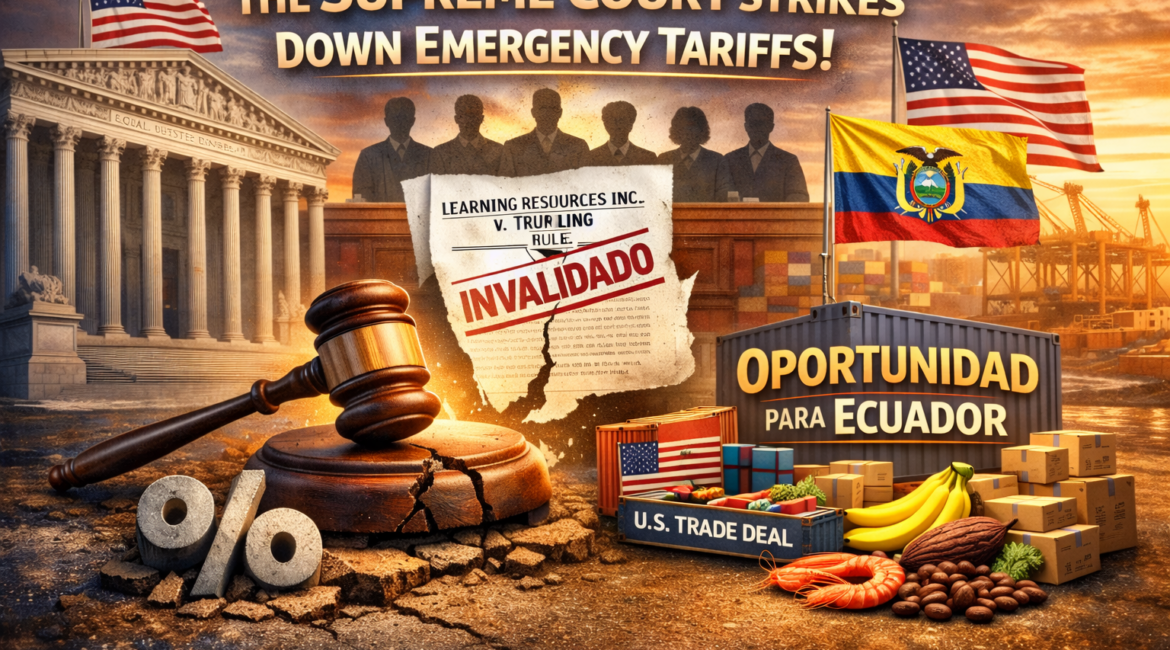
Friday, February 20, 2026 will be recorded as a turning point in the history of modern international trade. The Supreme Court of the United States, by a sweeping majority of six votes to three, struck down the global tariffs imposed by President Donald Trump under the International Emergency Economic Powers Act (IEEPA). For Ecuador — a country that spent months negotiating a Reciprocal Trade Agreement with Washington and that exports billions of dollars annually to the U.S. market — the ruling is not just international news: it is both a warning signal and a window of opportunity.
The Ruling That Changed the Rules of the Game
The case that reached the Supreme Court, known as Learning Resources Inc. v. Trump, consolidated lawsuits from several small businesses and a coalition of states challenging the legality of the tariffs imposed as of April 2, 2025 — the so-called “Liberation Day” tariffs. In his majority opinion, Chief Justice John Roberts was categorical: IEEPA does not authorize the president to impose tariffs. The reasoning is grounded in constitutional principle: under U.S. law, the power to impose taxes — and tariffs are taxes — belongs to Congress, not the Executive Branch.
The ruling invalidates tariffs that had affected virtually every trading partner in the world, with rates ranging from a 10% global base to figures as aggressive as 50% on Brazilian imports or 145% on Chinese goods during the first quarter of 2025. However, the decision has important limits: it does not affect sector-specific tariffs imposed under other statutes, such as the steel and aluminum tariffs based on Section 232 of the Trade Expansion Act. Protectionism does not die with this ruling — it simply loses its most powerful and flexible instrument.
“The Government reads IEEPA to give the President power to unilaterally impose unbounded tariffs and change them at will. Those words cannot bear such weight.” — Chief Justice John Roberts, majority opinion.
Trump’s Response: Protectionism Does Not Back Down
On the very same Friday the ruling was issued, President Trump announced at a press conference a new global tariff of 10% under Section 122 of the Trade Act of 1974 — a different statute that had never been invoked by any president in its fifty years of existence. The following day, Saturday the 22nd, he raised that figure to 15%, effective February 24 for a period of 150 days — the legal maximum under that section. Additionally, the White House announced the launch of investigations under Section 301, a mechanism that could lead to new, more targeted tariffs without time limits in the coming months.
The tariff landscape, therefore, does not return to its starting point. The effective U.S. rate on global imports shifts from emergency levels — averaging between 20% and 50% for various trading partners — to a 15% general base with sector-specific exemptions. That is a significant reduction, but it still represents the highest level of protectionism in over 60 years.
Ecuador in the Eye of the Storm: The Reciprocal Trade Agreement in Limbo
At the time of the ruling, Ecuador found itself in a singular position: it is one of the few Latin American countries that had successfully closed negotiations with Washington on a Reciprocal Trade Agreement (RTA), pending only formal signature. That agreement, negotiated under the pressure of IEEPA tariffs, promised to eliminate duties on 50% of Ecuador’s exportable supply to the U.S. market.
With the Supreme Court’s ruling, the logic underpinning that agreement changes dramatically. Ecuador’s Minister of Production, Foreign Trade and Investment, Luis Alberto Jaramillo, announced that Ecuador “immediately” activated formal communication channels with the Office of the U.S. Trade Representative (USTR). For his part, U.S. Trade Representative Jamieson Greer publicly stated that Washington intends to honor and fulfill the agreements already negotiated. Nevertheless, analysts such as economist Alberto Acosta urge caution: “The power asymmetry has been reduced. And when asymmetry decreases, urgency ceases to be rational. Signing now would mean granting structural access to the Ecuadorian market in exchange for a problem that the U.S. justice system itself has already acknowledged.”
In concrete terms, the new 15% tariff under Section 122 includes an Annex II with sector-specific exemptions. According to initial analyses, approximately 30% of Ecuador’s non-petroleum exports would be exempt: bananas, plantains, cocoa and semi-processed cocoa products, some fresh fruits, fishery products, and certain wood items. The remaining 70% would face the 15% surcharge — a lighter burden than the IEEPA tariffs, but not negligible for sectors such as cut flowers, processed shrimp, or manufactured goods.
What Ecuadorian Companies Should Do Right Now
Regulatory volatility is the worst-case scenario for any foreign trade operation: contracts signed under a tariff structure that can change within days, logistics planned around costs that are recalculated week by week, and margins eroded by every presidential announcement. In this environment, specialized advisory is not a luxury — it is an operational necessity.
Priority actions for Ecuadorian foreign trade companies include reviewing the HTS (Harmonized Tariff Schedule) classification of their products under Annex II of the new Section 122 decree; evaluating whether they are eligible for refunds on IEEPA tariffs paid between April 2025 and the date of the ruling — the U.S. Court of International Trade has already confirmed its jurisdiction to order refunds through reliquidation; and closely monitoring the Section 301 investigations that could give rise to new sector-specific tariffs in the coming months. The uncertainty does not end with the ruling — it simply reorganizes.
─────────────────────────────
Tranexteint: Your Strategic Partner in Foreign Trade
In an environment like this one — where a judicial ruling can reshape the cost structure of an entire import or export operation within hours — having a specialized team makes the difference between reacting too late and anticipating with intelligence. At Tranexteint, we have been supporting Ecuadorian companies in their foreign trade operations for years, from tariff classification and customs management to the structuring of import and export strategies designed to withstand the shifts of the international market. If you have questions about how the U.S. Supreme Court ruling affects you, what will happen to the Reciprocal Trade Agreement, or how to position your company in light of the new 15% tariff under Section 122, contact us. Our team is ready to analyze your specific situation and help you make well-informed decisions in this new chapter of global trade.
─────────────────────────────
Sources
1. Supreme Court of the United States – Opinion in Learning Resources Inc. v. Trump (No. 24-1287, decided Feb. 20, 2026)
2. Tax Foundation – “Supreme Court Trump Tariffs Ruling: Analysis” (Feb. 20, 2026)
3. Holland & Knight – “Supreme Court Strikes Down IEEPA Tariffs: What Importers Need to Know Now” (Feb. 20, 2026)
4. El Universo (Ecuador) – “¿Qué pasará con las sobretasas y el acuerdo con EE.UU. tras dictamen judicial?” (Feb. 20, 2026)
5. Diario Expreso (Ecuador) – “EE.UU. buscará salvar acuerdos comerciales con sus socios. ¿Qué pasará con Ecuador?” (Feb. 23, 2026)
6. NBC News – “Supreme Court strikes down most of Trump’s tariffs in a major blow to the president” (Feb. 20, 2026)
7. Chatham House – “US Supreme Court strikes down Trump’s tariffs: Early analysis” (Feb. 23, 2026)
8. NPR – “GOP-led Senate rebukes Trump on tariffs for a third time” (Oct. 30, 2025)
