
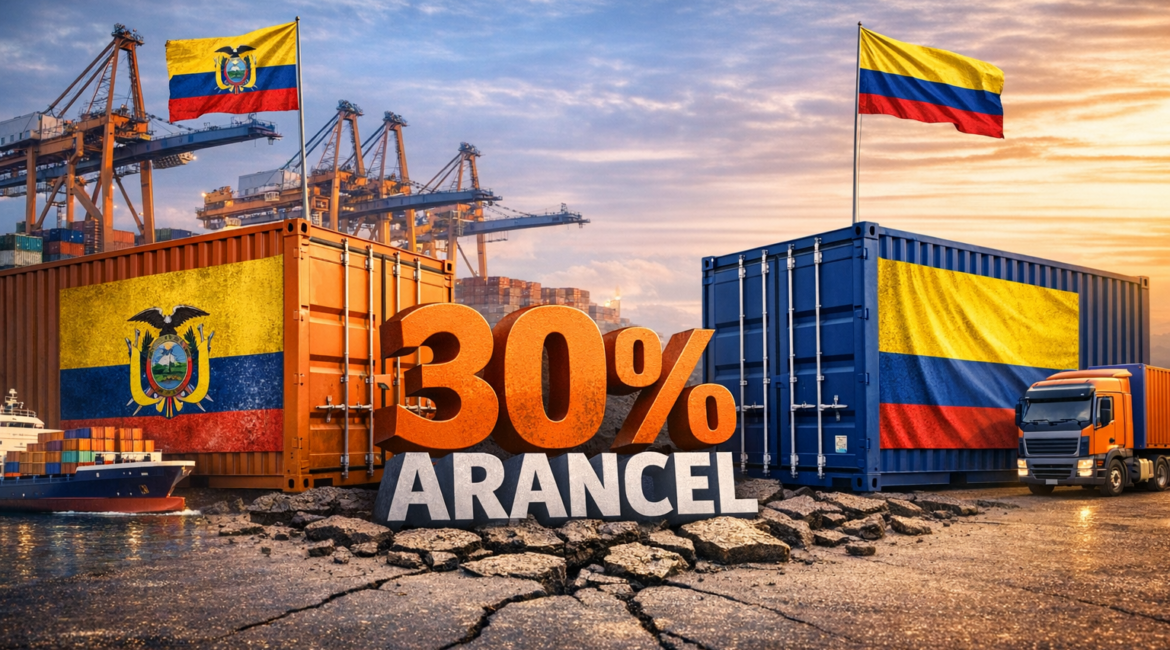
On January 21, 2026, Ecuador announced a 30% tariff (described as a “security fee”) on imports from Colombia, set to take effect on February 1, 2026. The measure was framed as a response to alleged insufficient cooperation on border security, particularly against drug trafficking and illegal mining, and to a persistent trade deficit. In the days that followed, Colombia signaled and implemented countermeasures, increasing uncertainty for regional supply chains and placing disproportionate pressure on small and medium-sized enterprises (SMEs) that depend on predictable cross-border trade flows.
1) What Ecuador Announced and the Rationale Behind It
Ecuador’s President Daniel Noboa stated that Ecuador would apply a 30% tariff on imports from Colombia starting February 1, arguing a lack of “reciprocity” and “firm actions” from Colombia regarding security cooperation in the border area. The announcement was made while the president was abroad attending the World Economic Forum in Davos, and the message emphasized that the measure would remain in place until Ecuador perceives a “real commitment” to joint action against transnational crime.
Alongside the security narrative, Ecuador tied the measure to trade balance concerns. Noboa referenced an annual trade deficit exceeding USD 1 billion, highlighting that Ecuador believes it has pursued dialogue while still facing significant security challenges at the border.
The underlying commercial relationship is substantial. According to figures cited in coverage of the announcement, Colombian exports to Ecuador reached USD 1.673 billion between January and November 2025, while Ecuadorian exports to Colombia totaled USD 808 million over the same period. This asymmetry helps explain why a broad-based 30% surcharge—despite its stated security intent—immediately raises concerns about a systemic cost shock to bilateral commerce.
For logistics and compliance teams, the practical point is straightforward: a uniform 30% tariff can materially change landed costs across a wide set of HS codes, forcing rapid revisions of pricing, procurement strategies, and working capital requirements—particularly for companies that rely on Colombian inputs or finished goods as part of their operating model.
2) Colombia’s Response: Counter-Tariffs and Energy Measures
Colombia’s response arrived quickly and combined trade and energy signals. On January 22, 2026, Colombia announced a 30% tariff on 20 Ecuadorian products, described as “proportional, transitory and revisable,” and indicated willingness to engage in dialogue while reserving the option to expand measures if necessary.
In parallel, Colombia took action in the electricity sector. Ecuadorian media reported that Colombia suspended electricity sales to Ecuador effective 18:00 on January 22, with Ecuador’s operator data showing imports dropping to zero shortly after. Ecuador’s government, in turn, communicated that the national power system could cover demand autonomously and cited real-time operating availability, reservoir energy levels, and the day’s dispatch composition (including a small share previously supplied via imports).
This energy component matters for businesses even when authorities emphasize system resilience. Electricity-related decisions can influence investor sentiment, production planning, and operational risk calculations—especially for energy-sensitive sectors and export-oriented manufacturing that cannot tolerate volatility.
Ecuador also referenced possible reciprocity measures linked to oil logistics. Ecuador’s Minister Inés Manzano stated that the transportation tariff for Colombian crude through Ecuador’s OCP pipeline would receive “reciprocity” comparable to the electricity issue. El Comercio noted there is no official figure on daily Colombian volumes transported via OCP, citing a source estimate of at least 7,000 barrels per day, while OCP’s operational capacity is far higher. Even as a signaling measure, linking trade policy tension to strategic infrastructure adds another layer of risk for stakeholders.
3) The Logistics and Cost Impact: What Changes Immediately for Importers and Exporters
A 30% tariff is not a marginal adjustment; it can redefine the economics of cross-border transactions. In real operations, impacts tend to cascade across the entire chain:
Higher landed cost and margin compression.
For Ecuadorian importers, the 30% surcharge increases the effective landed cost (depending on the contract structure and Incoterms). Many SMEs import on tight margins; absorbing a sudden 30% increase is often unrealistic, so the pressure shifts to renegotiation, reduced volumes, or passing costs downstream—each with commercial risks.
Working capital stress.
A higher import cost means more cash tied up per shipment. SMEs typically have limited access to low-cost financing, which can force them to shrink purchase orders, reduce inventory buffers, or delay replenishment—raising the probability of stockouts or production interruptions.
Contract friction and renegotiation cycles.
When tariffs change abruptly, disputes can arise over who bears incremental costs, especially if contracts do not clearly allocate responsibilities for new duties or “extraordinary charges.” Even well-drafted agreements still require time to implement amendments, and shipments already in transit may arrive under new conditions.
Customs and documentation pressure.
Policy shifts often lead to heightened scrutiny at the border: classification reviews, valuation checks, or intensified controls around origin. This can slow clearance, increase demurrage/warehouse costs, and introduce unpredictability in delivery times—particularly damaging for perishable goods and just-in-time supply chains.
Modal shifts and re-routing attempts.
Companies may attempt to reconfigure sourcing routes, change suppliers, or move to alternative origins. But switching suppliers is rarely instant: it requires qualification processes, quality assurance, price renegotiations, and sometimes regulatory adjustments. SMEs tend to have fewer alternatives and less bargaining leverage, making them more exposed.
In short, the tariff’s impact is not limited to a headline percentage: it affects pricing, inventory strategy, compliance workloads, and transport planning simultaneously.
4) Why SMEs Are Hit Hardest, and the Regional Rules Question
SMEs are consistently the most vulnerable group in trade disputes because they have less capacity to absorb shocks and fewer options to diversify quickly.
SMEs in Ecuador that rely on Colombian inputs—components, packaging, consumer goods, or industrial supplies—face immediate cost inflation and may be forced to reduce production, adjust product lines, or increase retail prices, which can lower demand. The risk is not only financial; it is operational: delayed inputs can disrupt delivery commitments and strain client relationships.
SMEs in Colombia that export to Ecuador face an abrupt reduction in competitiveness. Buyers in Ecuador may postpone or cancel orders, request deep discounts, or switch to alternative suppliers. For smaller exporters with limited market diversification, losing Ecuador as a stable buyer can cause revenue volatility and employment pressure.
There is also a governance dimension: Ecuador and Colombia are members of the Andean Community (CAN). CAN’s Secretariat notes that its mission is to ensure intra-community trade is not affected by unilateral obstacles, under the Trade Liberalization Program of the Cartagena Agreement (Articles 72 and 73). This framework can become relevant if one party challenges the measure as inconsistent with regional commitments, potentially prolonging uncertainty even if political talks proceed in parallel.
For businesses, this legal-institutional layer matters less for immediate shipments and more for scenario planning: disputes that evolve into formal processes can extend the timeframe of uncertainty, affecting investment and procurement decisions throughout 2026.
A High-Cost Path for Both Economies—and a Disproportionate Burden for SMEs
Ecuador’s announcement of a 30% tariff on Colombian imports on January 21, 2026 and Colombia’s counter-tariffs on 20 Ecuadorian products, coupled with the temporary suspension of electricity sales, indicate a dispute that has moved beyond rhetoric into measures with real operational consequences.
The most immediate effects are higher costs, renegotiation pressure, and slower decision-making in supply chains. Over time, the greater risk is structural: weakened confidence between trading partners, reduced bilateral volumes, and a heavier drag on SMEs—companies that typically drive employment and regional distribution networks but lack the financial resilience to endure prolonged volatility.
In this environment, proactive trade management becomes essential. The companies that respond best are those that quantify exposure by product and route, review contract clauses related to duties and force majeure-type events, strengthen customs documentation, and build alternative sourcing or destination strategies before disruptions become irreversible.
At Tranexteint, we help importers and exporters assess the real cost impact of tariff changes, improve customs and compliance execution, and design practical logistics and trade strategies to protect continuity and margins. If your company trades between Ecuador and Colombia—or depends on those flows indirectly—our team can support you with tailored, data-driven guidance for your specific operation.
Sources consulted: El País (Jan 21, 2026), Cambio Colombia (Jan 21, 2026), El Comercio (Jan 22, 2026), Reuters (Jan 22, 2026), Associated Press (Jan 22, 2026), Andean Community (CAN) official materials.
